 Mesa Fence Rental
Construction Site Fencing in Mesa
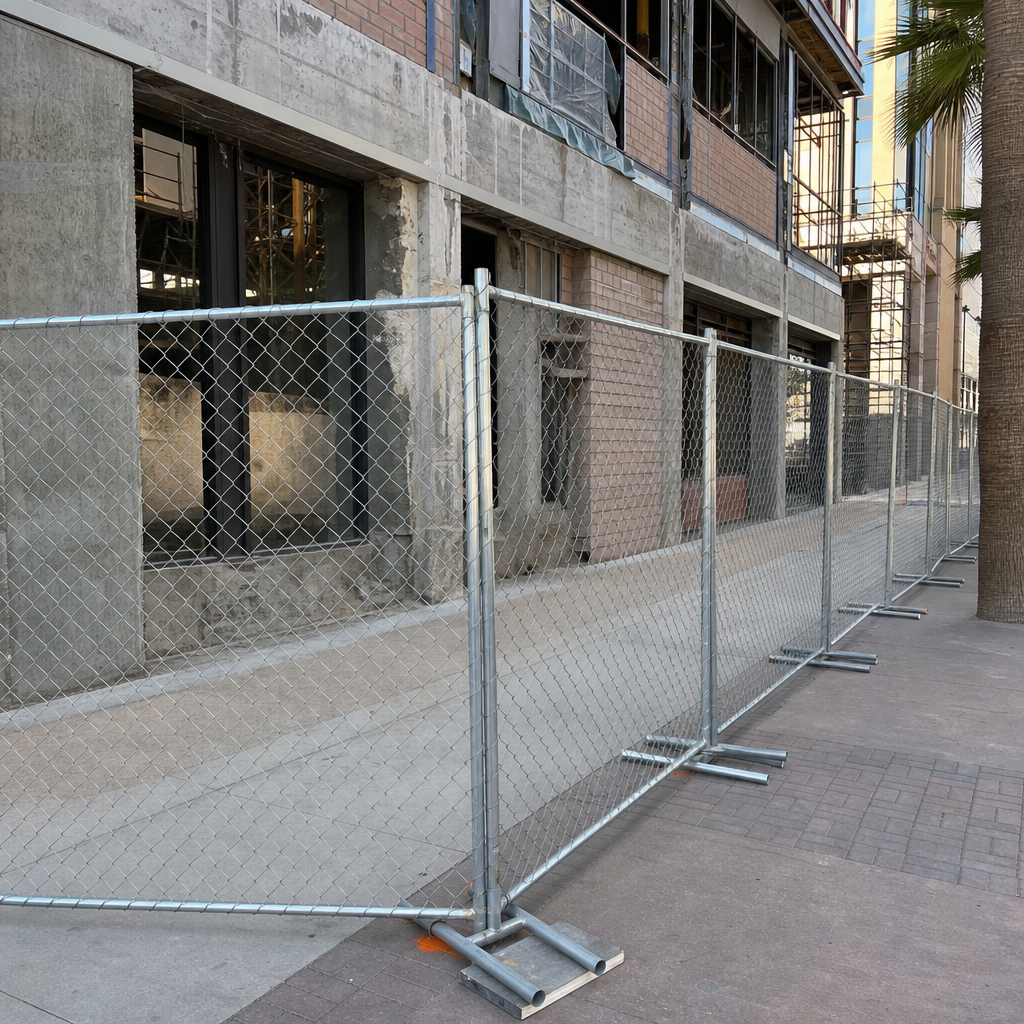
Construction site fencing in Mesa rents for $1.50–$3.00 per linear foot per month, installed on ballasted bases with gates where you need them and dust-control windscreen available. We fence residential infill, commercial pads, and industrial sites across Mesa and the East Valley.
If you’re a GC or super, you already know why the perimeter goes up first: theft, liability, and compliance, in that order. Here’s how all three play out in this specific market.
The Mesa construction market is three different fencing jobs
Southeast Mesa / Gateway. The corridor around Phoenix–Mesa Gateway Airport, ASU Polytechnic, and Eastmark is the busiest big-site market in the East Valley. The SR-24 extension pulled development straight down Signal Butte and Ellsworth: Destination at Gateway’s 163 acres of retail and auto mall, Medina Station at Southern and Signal Butte, the 1.6-million-square-foot Eastmark Center of Industry, plus data center and advanced manufacturing work along the Elliot Road Tech Corridor. These are long-perimeter jobs: 1,000–3,000+ feet of fence, multiple vehicle gates sized for belly dumps and lowboys, and windscreen because raw desert dirt out there moves the second the wind picks up. Our East Mesa page covers the corridor in more depth.
Downtown and central Mesa infill. Different animal entirely. Multifamily and adaptive-reuse projects along Main Street and the light rail line, plus the coming Palo District redevelopment of the old Fiesta Mall site, mean tight footprints, zero laydown space, pedestrian traffic on two sides, and fence lines that touch public right-of-way. That triggers City of Mesa right-of-way permitting and sometimes a traffic control plan, and it means panels on ballasted bases (no drilling the sidewalk), pedestrian canopies coordinated separately, and barricades where the sidewalk detours. We set fence around these constraints weekly.
Residential builds and remodels. Custom homes in Las Sendas and northeast Mesa, tear-down rebuilds in older central neighborhoods, casitas and garage additions. Usually 250–350 feet, one vehicle gate, done in a morning. If there’s a pool in the scope, read the temporary pool fencing page. The barrier requirement starts at excavation, not at plaster.
What a site perimeter costs
| Site type | Typical scope | Monthly cost |
|---|---|---|
| Residential build | 250–350 ft, 1 vehicle gate | $400–$800 |
| Commercial pad / TI | 500–800 ft, 2 gates, screen | $1,000–$2,000 |
| Industrial / big-box | 1,500 ft+, multiple gates, screen | $2,500–$3,000+ |
One-time delivery, install, and removal runs $100–$500 by distance and footage. Full rate card on the pricing page.
Against those numbers, weigh what unfenced sites lose in the East Valley: copper wire off spools, fuel out of parked equipment, tools out of unlocked conex boxes, and the occasional skid steer that drives away on a trailer. A fenced, gated, locked perimeter doesn’t make theft impossible. It makes your site harder than the next one, which is usually enough. It also documents due diligence for your builder’s risk carrier and cuts your exposure when a kid decides an open excavation looks interesting.
Panels, driven posts, or water-filled barriers: matching hardware to the site
“Construction fence” isn’t one product, and specs sometimes name hardware the writer never saw. Here’s how the options actually sort out on East Valley sites:
- 6-foot chain-link panels on sandbag-ballasted bases: the usual default and the right call on most sites. Surface-set (nothing driven through asphalt, post-tension slabs, or unlocated utilities), reconfigurable when the phase changes, and ballasted for monsoon wind. The 5-ft height variant exists for one reason: ARS 36-1681 pool barriers.
- Post-driven chain link: available where a site genuinely needs it and utility locates clear: long-duration perimeters on raw dirt where the line will never move. It holds wind well, but you give up relocation flexibility and it’s off the table on finished surfaces.
- Water-filled plastic barriers: a traffic-control product, not fencing. They exist to channel vehicles in roadway work zones, they’re specced by traffic engineers, and they don’t secure anything a person can step over. If your project fronts a live street, the plan may require them and fence, from two different vendors, and we will say so on the quote call rather than pretend one covers the other.
The wrong hardware fails inspection or fails in July wind; either way you pay twice. Describe the site in the quote request and we will spec what it needs; the panel spec sheet has the hardware detail.
Compliance: what actually applies in Mesa
- Maricopa County Rule 310. Disturb a tenth of an acre or more and you need a dust control permit and active suppression. Windscreen on the perimeter is one of the visible controls inspectors clock from the street. It supplements water trucks; it doesn’t replace them. Working east of Meridian Road? You’ve crossed into Pinal County’s separate dust program, same idea, different paperwork.
- Pool barriers. ARS 36-1681 covers swimming pools (18 inches or deeper, wider than 8 feet, intended for swimming), not retention basins or utility trenches. In Mesa the city’s pool code (M-ISPSC 305.1.1) requires 60-inch construction fencing around a pool from excavation until the permanent barrier is completed. Other open excavations fall under OSHA and your own site safety plan.
- City of Mesa right-of-way. Fence, dumpsters, or laydown in public sidewalk or street means a ROW permit and possibly traffic control. Budget lead time for it on downtown jobs.
- OSHA and your own contract. Controlled site access is baseline. Most commercial GC contracts specify perimeter fencing explicitly, and your super shouldn’t have to chase a fence sub to satisfy it.
We are a fence service, not your compliance consultant. We set lines with what inspectors here look for in mind, and we will tell you when something about your layout will draw attention. The inspector still makes the call.
Monsoon-rated, because July doesn’t care about your schedule
From mid-June through September, monsoon outflows push 50–70 mph gusts across open ground in southeast Mesa. Fence failure on a construction site isn’t a fence problem. It’s panels across a public street, into parked cars, onto stored materials. A sound install uses heavy sandbag-ballasted bases, with added bags and bracing on screened or exposed runs. If your fence carries windscreen through the summer, ask us how we will ballast it and what the honest trade-offs are. There’s a full breakdown in our monsoon fencing guide.
How it works on your job
- Send the site plan (or footage, gates, and dates). We quote you directly.
- A typical install: panels plumbed and clamped, gates hung, screen tied, ballast set. Get the install date in writing.
- Line moves when the job moves. Relocations at pours and phase changes are usually flat-rate service calls.
- Call for pickup at CO. We demob and billing stops. Month-to-month with no term lock-in is common; confirm it in the agreement.
GCs with multiple active sites can ask for a standing arrangement: one contact, one rate structure, fence that shows up when mobilization slips a week (it always slips a week). If that’s you, say so on the quote form.
A final scheduling note: in a market this busy, fence inventory tightens whenever several big sites mobilize the same month, a dynamic we covered in our post on the southeast Mesa boom. Reserve the perimeter when you schedule the conex and the temporary power, and it’s a solved problem instead of a week-one scramble.
Related: chain link fence panels for the hardware details, privacy screen & windscreen for dust and sightline control, and pricing for everything in one table.
Frequently Asked Questions
How much does construction site fencing cost in Mesa?
Standard 6-ft chain link runs $1.50–$3.00 per linear foot per month. A typical commercial site with 500–800 feet of perimeter, two gates, and windscreen lands around $1,000–$2,000/month; large industrial perimeters run $2,500–$3,000+. Delivery, install, and removal add a one-time $100–$500.
Does OSHA or the city require my job site to be fenced?
There's no blanket 'every site must be fenced' law, but the obligations stack up fast: OSHA expects hazards like open excavations to be protected, anything in the public right-of-way needs a City of Mesa permit, Mesa's pool code requires 60-inch construction fencing around a pool from the day of excavation, and most builder's risk policies and GC contracts require a secured perimeter. In practice, commercial sites fence.
Can the fence line be moved as construction phases change?
Yes, relocations are a flat service call, typically $100–$250. Pours, utility trenching, and phase turnovers are normal fence-moving events; give us a day or two of notice to shift the line.
Can windscreen be added for dust control?
Yes, at $0.50–$1.00 per foot per month. Perimeter screening is a visible dust control under Maricopa County Rule 310 and most SWPPP/dust plans. During monsoon season screened lines need added ballast because the mesh catches wind; ask us how we ballast them.
How fast can a new site be fenced?
It depends on footage and the calendar in Mesa, Gilbert, and Tempe; big footage (1,000+ ft) benefits from a few extra days' notice. If you've got a mobilization date, send the site plan with the quote request and ask us to plan for fence up before the first conex lands.
Should my site use chain-link panels or water-filled barriers?
They solve different problems. Six-foot chain link is site security: it stops people, secures equipment, and satisfies the fencing language in GC contracts and builder's risk policies. Water-filled plastic barriers are traffic control: they channel vehicles in roadway work zones, come from traffic-control vendors, and won't pass for a security perimeter. If your spec calls for both, that's two trades, and we will tell you which half is ours.